2026 Japanese Grand Prix Track Guide

Updated March 16, 2026


Updated March 16, 2026
The Japanese Grand Prix takes place at Suzuka Circuit, one of the most iconic and technically demanding tracks on the Formula 1 calendar. Located in Mie Prefecture and owned by Honda, Suzuka has been a staple of the championship since 1987. Drivers widely consider Suzuka to be one of the best circuits on the calendar due in particular to it's challenging 'Esses' section in Sector 1 and and the flat out 130R in Sector 3. Precision through high-speed sections and consistency across a lap are critical to achieving strong performance here.
Unlike most modern circuits, Suzuka features a unique figure-eight layout, with one section of the track crossing over another via a bridge. The circuit combines fast sweeping corners with technical sequences that reward rhythm, balance, and driver confidence.
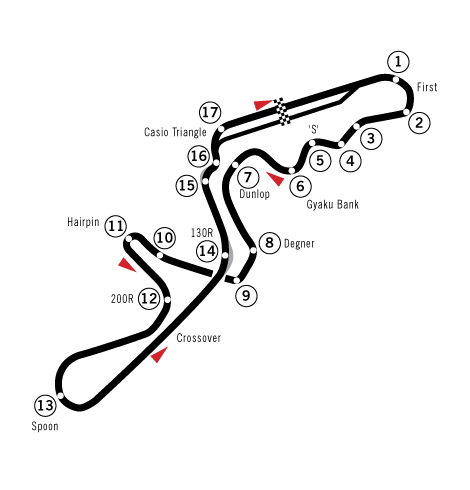
| Circuit | Suzuka Circuit |
|---|---|
| Location | Suzuka, Japan |
| Circuit Type | Permanent racing circuit |
| Lap Length | 5.807 km |
| Corners | 18 |
| Race Distance | 53 laps |
| Race Lap Record | 1:30.983 – Lewis Hamilton |
Suzuka’s layout features a series of high-speed directional changes, particularly through the opening Esses, that require precise car control and aerodynamic stability. Unlike circuits dominated by long straights, Suzuka places greater emphasis on maintaining momentum through corners.
Formula 1 enters a new technical era in 2026 with updated power units and revised aerodynamic concepts. At Suzuka, these changes highlight the importance of energy deployment efficiency, particularly as drivers look to maintain speed through long, flowing sections rather than relying on heavy braking zones. There is wide speculation that the Esses in particular will be taken more slowly with drivers trying to manage their power pack.
The narrower tires and reduced car size introduced under the new regulations may also make the high-speed corners more challenging. Maintaining stability through sequences like the Esses and 130R becomes even more critical, placing added emphasis on aerodynamic balance and driver confidence.
Suzuka Circuit is defined by its flowing layout and high-speed corner combinations. The opening sector features a sequence of Esses that demand precision and rhythm, while the middle sector includes technical corners that reward stability and traction.
Key characteristics include:
The circuit places a premium on maintaining momentum through corners rather than relying on straight-line speed. Small mistakes can carry significant time penalties due to the continuous nature of the layout.
Tire wear is generally balanced, but the sustained lateral loads through high-speed corners can place stress on both front and rear tires. Managing tire temperatures and maintaining grip across a stint is essential for consistent lap times.
The 2026 regulations emphasize efficiency in both aerodynamics and energy deployment, which aligns closely with the demands of Suzuka. Drivers must carefully manage energy output across a lap, as there are fewer heavy braking zones to recover energy compared to other circuits.
Track position remains highly valuable due to the limited overtaking opportunities. Qualifying performance often plays a major role in determining race outcomes, although strategy can still influence results through undercuts and well-timed pit stops.
Factor | Impact on Race Strategy |
|---|---|
Energy Deployment | Efficient energy usage is critical due to limited heavy braking zones for recovery |
Aerodynamic Balance | High-speed corners reward stable aero setups and consistent downforce |
Overtaking Difficulty | Track position is important as passing opportunities are limited |
Qualifying Position | Starting near the front significantly increases chances of a strong finish |
Because Suzuka rewards precision and consistency, races here are often shaped by small margins. Strategy decisions such as pit timing and tire selection can still play a role, but maintaining track position typically remains the primary factor in achieving a strong result.


