2026 Hungarian Grand Prix: Hungaroring Circuit Overview

Updated August 24, 2026


Updated August 24, 2026
The Hungarian Grand Prix takes place at the Hungaroring, a permanent racing circuit located near Mogyoród, just outside Budapest. First added to the Formula 1 calendar in 1986, it became the first Grand Prix held behind the Iron Curtain and has remained a regular part of the championship ever since.
The Hungaroring is often compared to a permanent street circuit because of its narrow layout, short straights and constant sequence of corners. Overtaking is difficult here, and drivers rarely get much time to rest across the lap. The circuit rewards precision, rhythm and patience more than raw straight-line speed.
Unlike power circuits such as Spa or Monza, the Hungaroring places a premium on downforce, traction and tire management. The lap flows from one corner into the next, meaning a small mistake can compromise several turns in sequence. Qualifying is therefore one of the most important parts of the weekend.
__PAYLOADIMG0__

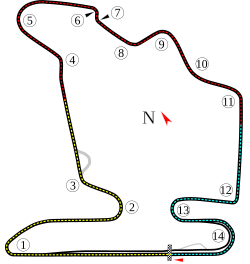
| Circuit | Hungaroring |
|---|---|
| Location | Mogyoród, Hungary |
| Circuit Type | Permanent racing circuit |
| Lap Length | 4.381 km |
| Corners | 14 |
| Race Distance | 70 laps |
| Race Lap Record | 1:16.627 – Lewis Hamilton (2020) |
The opening sector provides the main overtaking opportunity of the lap, with the long run into Turn 1 offering the best chance to pass under braking. After that, the circuit becomes far more technical, with a flowing middle sector and a final sector that demands patience, traction and rear tire control.
Because the lap is so compact and corner-heavy, traffic is also a major factor in qualifying. Drivers need clean air to build tire temperature properly and carry momentum through the long sequences of medium and low-speed corners.
Formula 1's 2026 technical overhaul could make the Hungaroring even more interesting from a setup perspective. The new cars are expected to place greater emphasis on aerodynamic efficiency and electrical energy deployment, but Hungary is not a circuit where pure top speed usually decides the result.
Instead, the key question will be how well teams can generate stable downforce through slower and medium-speed corners. The Hungaroring demands a car that rotates cleanly, puts power down without sliding and remains predictable during long corner sequences. Under the 2026 rules, any team struggling with balance could lose time across multiple parts of the lap rather than in one obvious braking zone.
Energy deployment will still matter on the run to Turn 1 and out of the final corner, but there are fewer long straights here than at circuits such as Montreal, Miami or Spa. That means efficient deployment helps, but mechanical grip, tire control and downforce remain the foundations of a strong Hungarian Grand Prix package.


The Hungaroring is defined by its tight, twisting layout and limited overtaking opportunities. The first corner is the main passing zone, but once the field settles into rhythm, drivers often need a significant pace advantage to make a move on track.
The middle sector is the heart of the lap. Turns 4 through 11 create a long sequence of direction changes where the car must remain stable, responsive and easy on its tires. There is very little time for drivers to reset between corners, so confidence in the front end is vital.
Key characteristics include:
Tire management is usually central to race performance at the Hungaroring. The circuit does not punish tires through extreme top speed, but the constant cornering load, limited cooling time and hot summer conditions can make overheating a real issue. Drivers who slide too much early in a stint often pay for it later.
The track surface can also evolve significantly across the weekend. Dust and low grip are common early in practice, but as more rubber goes down, lap times improve and the racing line becomes more defined. That can make off-line overtaking even harder by race day.
Strategy at the Hungaroring is shaped by one simple fact: overtaking is difficult. Teams place huge value on qualifying, track position and pit timing because recovering from a poor starting spot is rarely straightforward. A faster car can spend a long time stuck behind slower traffic if it cannot complete the move into Turn 1.
That makes the undercut especially important. Fresh tires can create enough pace to jump a rival during the pit cycle, but teams must weigh that against the risk of rejoining in traffic. Because the lap is short, gaps can disappear quickly, and a mistimed stop can leave a driver trapped behind midfield cars at the worst possible moment.
Under the 2026 regulations, energy deployment will likely play its biggest role on the main straight and into Turn 1. However, the broader race will still be decided by tire life, downforce and clean air. Drivers who can manage temperatures while staying close enough to pressure the car ahead will have the best chance of forcing a strategic opportunity.
Factor | Impact on Race Strategy |
|---|---|
Qualifying Position | Extremely important because overtaking is difficult and track position carries major value |
Undercut Potential | Fresh tires can help jump rivals during the pit cycle, but only if the driver rejoins in clean air |
Tire Overheating | Constant cornering and high temperatures can punish drivers who slide too much during a stint |
Energy Deployment | Most useful on the main straight and into Turn 1, the clearest overtaking zone on the circuit |
Traffic Management | A short lap and narrow racing line make traffic a major concern in both qualifying and race strategy |
Downforce Balance | Teams need a stable, high-downforce setup that protects tires without sacrificing rotation in slow corners |
Because of the limited passing opportunities, the Hungarian Grand Prix often becomes a race of pressure rather than constant overtaking. The driver behind must stay close enough to threaten an undercut or force a mistake, while the leader must manage tires without giving up track position.
The Hungaroring rewards discipline. A car with strong downforce, clean traction and gentle tire use can control the race from the front, but any team that loses position early may need a bold strategy call to get back into contention.
Affiliate DisclosureATS.io uses affiliate links. If you sign up through a link on this page, we may earn a commission at no additional cost to you. Rankings are based on hands-on testing and published criteria, and affiliate relationships do not determine placement.


